From Côte d’Ivoire in the west to Ethiopia in the east, Africa is home to some of the world’s fastest growing economies. Debates often proclaim a new era of economic boom, innovation and social opportunity for the continent. But beyond the hype, millions of people remain affected by severe poverty, and at the root of this lies a perennial problem: energy poverty. Could hydropower hold the key to energy access in Africa?
Rapid population growth looks set to further strain energy services, with some estimating that the continent’s population will surpass four billion by the end of the century.
Access to electricity is both limited and uneven. Economic powerhouses such as Egypt have almost total electricity coverage, but it remains scarce in countries such as Chad and Liberia, as well as South Sudan, where only 1.5 per cent of people have access to such energy. Similarly, step outside the continent’s cities and the picture is also bleak: the electrification rate for rural settlements is just 27.8 per cent.
In the face of rampant energy poverty, African governments are increasingly turning to renewable sources to spur development and improve lives and livelihoods. And a cornerstone of this move towards renewables is hydropower.

Source: Africa-European Union Energy Partnership
But the data shows a different picture. Hydropower produces more than three-quarters of the world’s renewable energy output each year. And its carbon emissions — over the entire lifecycle of construction, operation and decommissioning — are often far lower than those from all other renewable sources, including wind and solar.
Across Africa, hydropower is responsible for 84 per cent of all non-fossil fuel energy use. But in a continent rich in lakes and rivers, the opportunities for expanding hydropower are huge.
Proportion of global renewable energy generation from hydropower in 2012
Proportion of African energy use from non-fossil fuels in 2013
Proportion of African non-fossil fuel energy use from hydropower in 2013
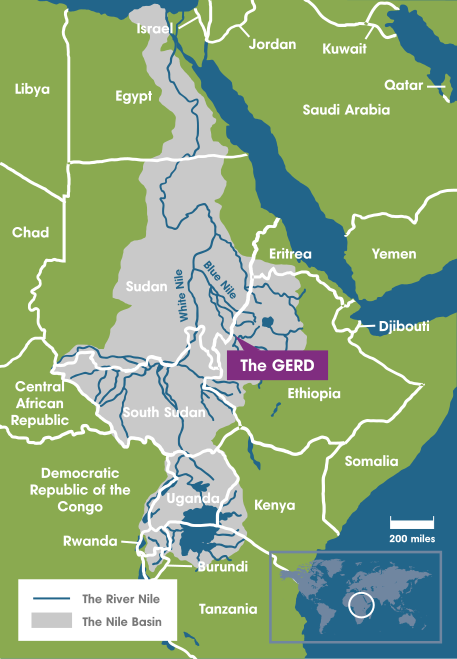
From its source in the African Great Lakes to its delta in Egypt, the Nile travels for almost 7,000 kilometres through habitats including mountains, tropical forests, desert, savannahs and wetlands, many of which are rich in biodiversity. Its drainage basin covers about a tenth of Africa’s land area and is shared by 11 countries.
For thousands of years, people living beside the river have depended on it. Agriculture has developed in harmony with rainfall patterns, and people have built small dams to harness the river’s water for crop irrigation. More recently, governments have started using the river to produce electricity.
But despite its length, the Nile carries relatively little water because it often flows through arid areas where there is little rainfall or water flowing through the ground. The river’s biodiversity is also vulnerable to climate change: rising temperatures are altering the Nile’s seasonal cycles, making droughts more likely as well as increasing evaporation from its lakes.
When planning a large hydroelectric dam on a major river such as the Nile, environmental factors such as these need to be considered, despite the risk that this will impede work or boost upfront costs. Researchers should study how a region’s water cycle integrates with biodiversity and local people’s lives, and factor their findings into the proposed design.
Producing environmental assessments that adhere to international standards can help lessen some of the disputes associated with dam projects, such as those relating to alterations to water flow. Assessments have been carried out for the Grand Ethiopian Renaissance Dam (GERD), a huge hydropower plant being built on the Blue Nile, one of the river’s two main tributaries. But critics say the assessments lack detail and fail to meet international standards.
The GERD is being built in the Benishangul-Gumuz region of Ethiopia, just upstream from the Sudanese border. On completion in 2017, it is planned to be 145 metres high — nearly one-and-a-half times the height of Victoria Falls — making it the highest dam in Africa. Its reservoir is set to contain 74 billion cubic metres of water, roughly the same as 13 times Ethiopia’s total annual water consumption. The Ethiopian government expects the dam to produce six gigawatts of energy at peak output. This will almost triple Ethiopia’s electricity production, which currently stands at less than three gigawatts.
Hydropower projects often split opinion. They can provide abundant clean energy for around 50 years without major maintenance and, unlike other renewables such as solar or wind, they produce continuous power.
But the upfront costs of designing and constructing big dams such as the GERD are high. And the impact on local people can be severe, particularly for those displaced from their homes. In the case of the GERD, the economies and biodiversity of the two countries downstream, Egypt and Sudan, may also be affected, as the boxes below explain.



Scientists at intergovernmental organisation the Eastern Nile Technical Regional Office in Ethiopia are evaluating the potential impacts of different reservoir filling times on water flow downstream, to help inform policymakers in the three countries about how Nile-dependent crop irrigation and energy production might be affected.
SciDev.Net commissioned the office to produce a report on some key impacts (see ‘Further reading’ below). The study forms the basis of the interactive graphic below.
Step into the shoes of a policymaker to see how different filling scenarios will affect regional energy production, agriculture and economies.
Slide the button at the top to see the potential impact on Egypt, Ethiopia and Sudan if the GERD reservoir is filled over five, six or seven years — the most likely filling scenarios. Use the three buttons on the left to switch between the different impacts affecting these countries. Roll over the buttons to learn more about these impacts. The data comes from a predictive model based on production at Egypt’s High Aswan Dam.
Source: Wikipedia
Although progress in developing hydropower plants has been limited since 2010 — after a boom in 2009 when a number of plants began production — many are planned on Africa’s main rivers, including on the Congo. If all of these are built, they would together be able to generate nearly 27 gigawatts of electricity. Six plants, all with a peak power output larger than one gigawatt, are due to be up and running by 2020. Three of them — including the GERD — will be in Ethiopia, two in Angola and one in Mozambique.
Many energy experts consider large dams to be vital to solving Africa’s energy supply crisis. But they come with a complex set of social and environmental challenges.
To help tackle these, international hydropower associations and development banks are working to develop sustainability standards: guidelines that will assess the continent’s water resources and energy needs, and could help shape Africa’s future hydropower plans.
With such standards in place, it is hoped Africa will be able to boost its energy output, while also ensuring the integrity of its water resources and protecting the lives and livelihoods of its people. The next few decades could prove critical to the future of Africa’s water, energy and people.

 Tweet
Tweet Share
Share Email
Email